What Are TADs in Orthodontics? A Simple Guide
Written by Dr Mustafa, Specialist Orthodontist · PhD · GDC No. 105727
If your orthodontist has mentioned something called a “TAD” or a “mini-screw,” it’s completely natural to feel a little uneasy. The word screw on its own sounds more dramatic than the reality.
Here’s the reassuring truth: a TAD is tiny, placing one is quick, and it’s a routine part of modern orthodontics. It simply gives us a steady point to work from, so certain teeth can be moved more precisely, sometimes avoiding the need for bulkier options like headgear, or even surgery.
I’m Dr Mustafa, a specialist orthodontist, and in this guide I’ll explain exactly what TADs are, whether they hurt, and why they’re sometimes used, in plain English, without the jargon.
What Are TADs?
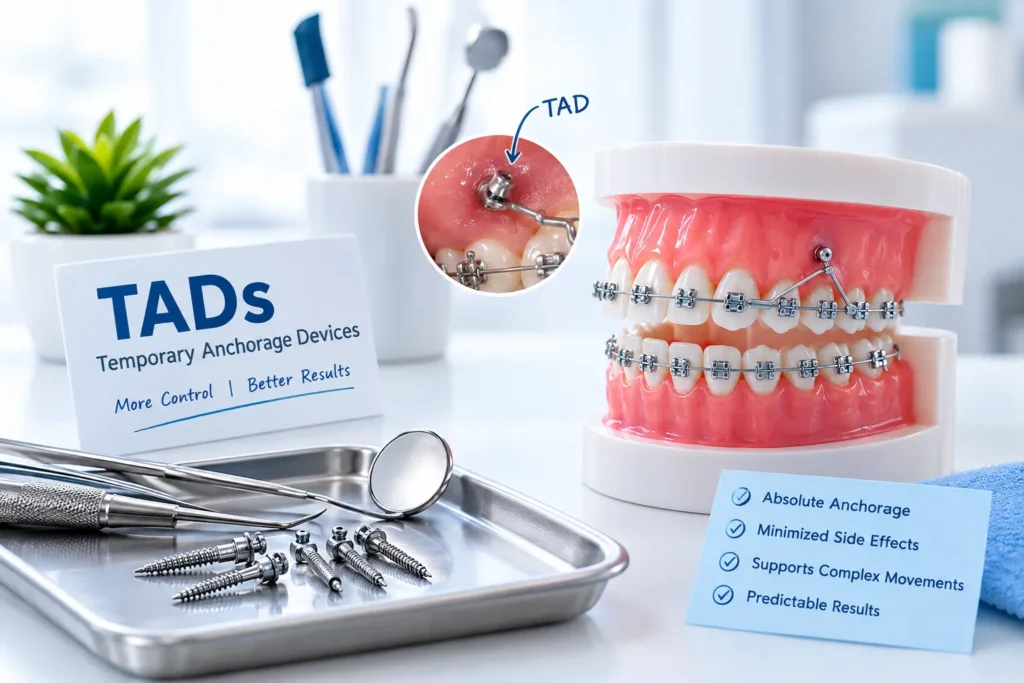
TAD stands for Temporary Anchorage Device, though you might also hear it called a mini-screw or mini-implant. It’s a small titanium pin, much smaller than most people picture, that’s placed gently into the bone to act as a steady anchor point during treatment.
To understand why that anchor matters, it helps to know how braces actually work. To move one tooth, you need something firm to push or pull against. Normally we use other teeth for this, but those teeth can sometimes drift out of place themselves, which isn’t what we want. A TAD solves that. Because it’s fixed into the bone, it stays put completely, giving us a reliable point to move teeth from without affecting the rest.
And as the name says, it’s temporary. Once it’s done its job, usually after a few months, it’s simply removed, and the small site heals on its own.
Why Are TADs Used?
Not everyone having braces needs a TAD; they’re only used when there’s a clear reason. Usually, that reason is control.
Some tooth movements are straightforward. Others are trickier, and trying to do them with ordinary braces alone can cause the “anchor” teeth to shift the wrong way. A TAD takes that risk away by giving us a completely fixed point to work from. That means we can be far more precise, moving exactly the teeth we want, in exactly the direction we want, while leaving everything else untouched.
They’re especially useful for things like:
- Closing larger gaps between teeth
- Correcting deep bites or open bites
- Moving teeth that are stuck or haven’t come through properly
- Pushing back teeth that have drifted forward
There’s a bigger benefit too. In the past, cases like these often meant wearing bulky headgear, or in some situations, jaw surgery. TADs have changed that. For many patients, they offer a far more discreet, comfortable way to achieve the same result, and that fits with how we like to work: using the most precise, least invasive approach that will get you there.
Do TADs Hurt?
This is the question almost everyone asks, and it’s a fair one. The honest answer: no, having a TAD placed isn’t painful.
Before it’s fitted, the area is numbed with a little local anesthetic, so you won’t feel anything sharp during the placement itself, just some gentle pressure. The whole thing usually takes only a few minutes. Most patients are genuinely surprised by how quick and simple it is, especially after worrying about it beforehand.
For a day or two afterwards, you might notice some mild tenderness around the spot, a bit like a dull ache. It usually settles quickly. Alongside TAD placement, braces can also cause some soreness as your teeth adjust to treatment, particularly during the first few days after they’re fitted or adjusted. Knowing how to manage initial braces soreness can make this part of your orthodontic journey more comfortable.
And taking a TAD out? That part’s even easier; it’s quick and often doesn’t even need numbing.
Are TADs Safe?
Yes. TADs are made from titanium, the same safe, body-friendly metal used in medical and dental implants for decades. They’ve been a routine part of orthodontics around the world for years, and placing one is a small, minimally invasive step.
One worry I hear now and then is whether a TAD can damage the bone. It’s an understandable thing to ask, but it isn’t the case. The screw sits in the bone only while it’s needed, and once it’s removed, the small spot heals over naturally on its own, usually within a couple of weeks, leaving nothing behind.
Like anything in treatment, the key is who’s doing it. When a TAD is planned carefully and placed by an experienced specialist, in the right spot, the right way, it’s a safe, predictable part of getting you the result you’re after.
Are There Any Risks with TADs?
Like any procedure, TADs do carry a few small risks, and it’s only fair to be upfront about them. The good news is that they’re uncommon, usually minor, and easily managed.
The most common one is simply that a TAD can work loose before it’s finished its job. If that happens, it isn’t painful or harmful; we just remove it and, if it’s still needed, place a new one. There’s also a small chance of irritation or infection around the site, which is why keeping the area clean matters. In the rare case it does occur, it’s easily treated.
A couple of less common risks, like the screw sitting too close to a tooth root, are mostly avoided through careful planning. This is exactly why where and how a TAD is placed matters so much. With proper assessment, X-rays where needed, and an experienced specialist doing the placement, the chances of any problem are kept very low.
In short: TADs are a safe, well-established part of orthodontics. Knowing the small risks simply helps you feel informed, not worried.
What to Expect: Placement and Removal
If a TAD is part of your plan, here’s what the whole thing actually looks like, because knowing what’s coming takes a lot of the worry out of it.
Having it placed. First, we numb the area with a little local anaesthetic. Once it’s numb, the TAD is gently fitted into place; you’ll feel some light pressure, but nothing sharp. From start to finish, it usually takes just a few minutes, and you can get straight back to your day afterward.
While it’s in, a TAD is small and sits neatly in your mouth, so most people barely notice it after the first few days. Looking after it is simple too; you just keep it clean with gentle brushing, the same as you would the rest of your teeth.
Taking it out. Once the TAD has done its job, usually after a few months, removing it is quick and easy, often without any numbing at all. The small spot heals over by itself shortly after.
That’s really all there is to it. For such a small thing, a TAD can make a real difference to how smoothly your treatment goes.
Advanced, Gentle Treatment at Our Clinic
At Ocean Orthodontic Clinic in Leith, Edinburgh, TADs are one of the modern tools we use to treat more complex cases with real precision, and often without needing bulkier or more invasive options.
Treatment is led by Dr Mustafa, a specialist orthodontist with over 20 years’ experience. Whether a case is simple or complicated, the aim is always the same: the most precise, least invasive approach that gets you a healthy, confident smile, looking after your teeth and comfort every step of the way.
If a TAD has been suggested as part of your treatment, you can feel reassured that it’s a small, routine step, and one that’s planned carefully around you.
Ready to talk about your smile?
Book a no-obligation consultation with our specialist orthodontic team here in Leith, Edinburgh. No referral needed, no pressure, just honest, expert advice tailored to you.
Got Questions?
Frequently asked questions
Written By:
Dr. Mustafa
Dr Mustafa is a GDC-registered specialist orthodontist (No. 105727) with a PhD in orthodontics and over twenty years’ experience treating patients across Edinburgh and the Lothians. A multi-award-winning clinician, he’s known for straightening teeth without unnecessary extractions and for a calm, honest approach with patients of every age. He leads the specialist team at Ocean Orthodontic Clinic in Leith.
Ready to start your smile journey?
Book a consultation with Dr Mustafa, our GDC-listed specialist orthodontist in Edinburgh.
Book Your Consultation or call 0131 202 4343